Lower back pain from prolonged sitting affects over 80% of office workers at some point in their careers. If you experience a dull ache, stiffness, or sharp pain after hours at your desk, you’re dealing with one of the most common occupational health issues in modern society.
Lower back pain from sitting is highly preventable and treatable with proper ergonomics, targeted exercises, and movement strategies.
Why Sitting Hurts Your Lower Back
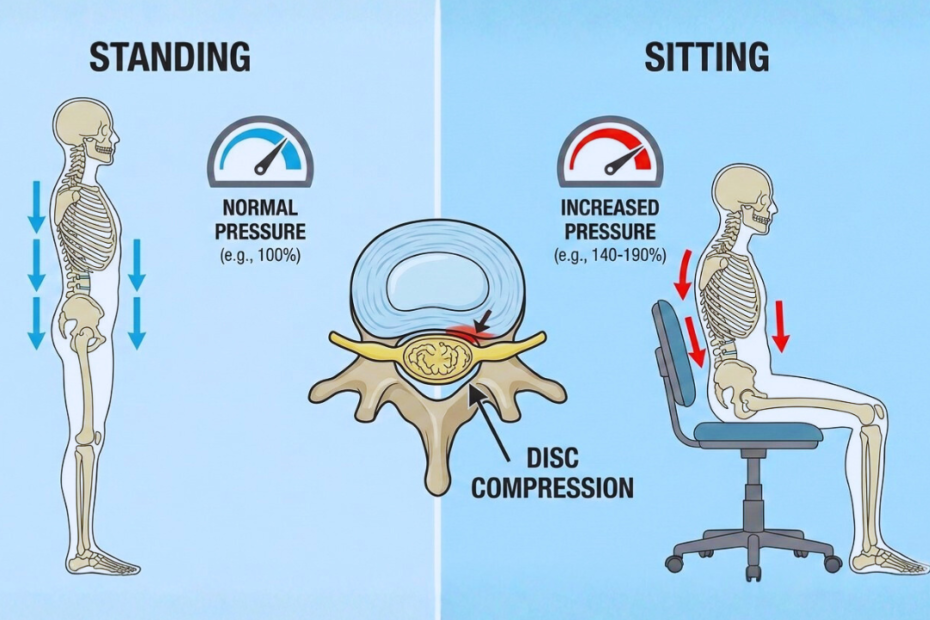
Sitting increases lumbar disc pressure by 40-90% compared to standing
Slouched sitting can increase pressure by up to 185%
Static positions reduce circulation to spinal structures
Prolonged siting will cause Muscle Deconditioning and Imbalances like tightness or over stretch
Perform 2-3 times daily, especially morning and evening
Caution: Avoid if pain increases
4. Seated figure of four stretch
Target: Glutes, hamstrings tension relief
Sit upright on the floor with your legs straight and hands placed on the ground on the outside of your hips for balance.
Place your right ankle over your left knee and bend your left knee until you feel a comfortable stretch in the right hip and place the sole of your left foot on the floor.
Hold the stretch for 15-30 seconds and repeat with the opposite side.
5. Pelvic bridging
Target: Glutes, hamstrings, lumbar stabilizers
Lie on back, feet flat, hip-width apart
Drive through heels, lift hips
Squeeze glutes at top, don’t hyperextend
Lower slowly
Perform 3 sets of 15-20 reps, 4-5 times per week
6. Child’s Pose (Decompression)
Target: Lumbar decompression, relaxation
Kneel, sit back on heels
Extend arms forward, lower chest
Breathe deeply, allow back to relax
Hold 60-90 seconds
Perform multiple times daily
Alternative: If knees hurt, place pillow between thighs and calves
References
Hartvigsen, J., et al. “What low back pain is and why we need to pay attention.” The Lancet 391.10137 (2018): 2356-2367.
Claus, A. P., et al. “Is ‘ideal’ sitting posture real? Measurement of spinal curves in four sitting postures.” Manual Therapy 14.4 (2009): 404-408.
McGill, S. M. Low Back Disorders: Evidence-Based Prevention and Rehabilitation. 3rd ed. Human Kinetics, 2015.
Callaghan, J. P., and McGill, S. M. “Intervertebral disc herniation: studies on a porcine model exposed to highly repetitive flexion/extension motion with compressive force.” Clinical Biomechanics 16.1 (2001): 28-37.
O’Sullivan, P. B., et al. “Multidimensional approach for the targeted management of low back pain.” Physical Therapy in Sport 12.4 (2011): 244-250.
Dr. Tom Walters with glen cordoza “Back and Spine protocols.” Rehab Science how to overcome pain and heal from injury 19.1 (2023): 281-303.